Book 1 - Lust
Footnotes
for
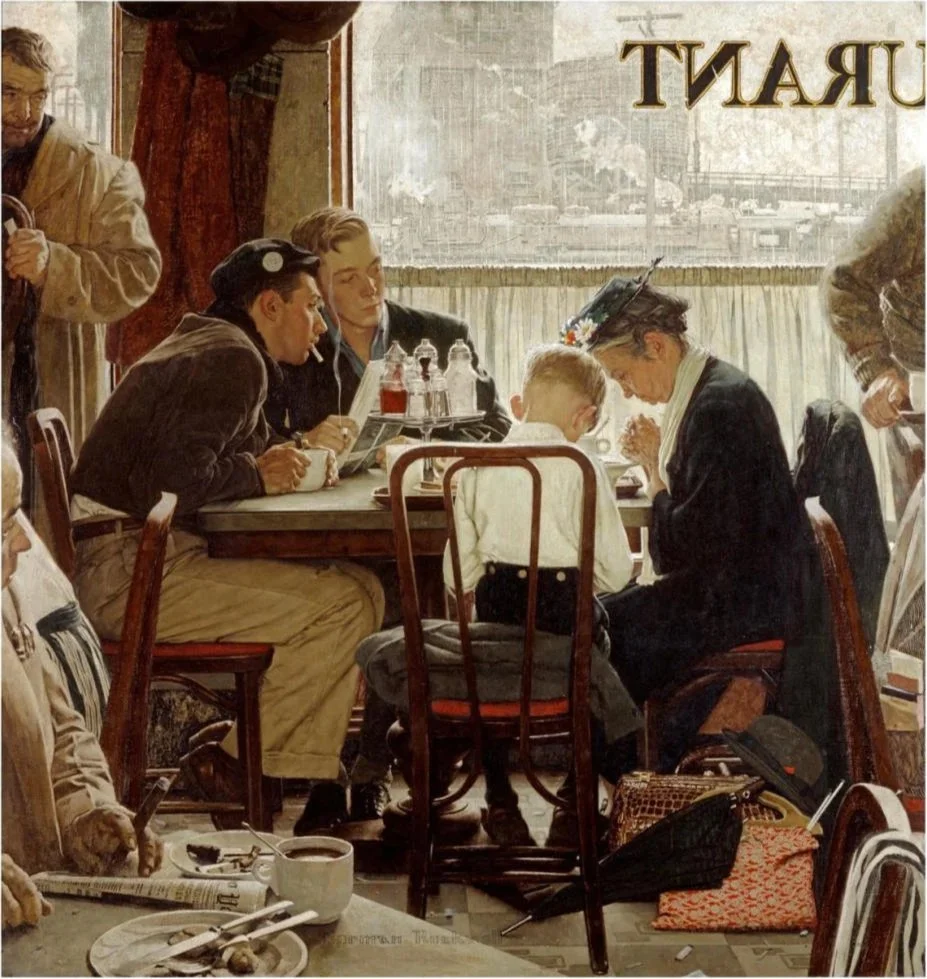
41. Saying Grace by Norman Rockwell
SPOILER ALERT
Obvious to all, and unsurprising obliviously to you, you have ignored more spoiler alerts than basic life advice…
However …..
To those who actually bought the book, it obvious to all that your nobility is only surpassed by the competition between your wisdom and humility
SPOILER ALERT
Reference Type
Cultural Historical
Theological Philosophical
Political Artistic
The Story
Excerpt from
Book 1 - Lust
Chapter X - The Hunt
The visitor would reread the card and look around in wonder and their stated business completely forgotten and then the golden arrow on the other side of the foyer, originally ignored would become a beacon. Moving without thought his foot would land on the searching the direction indicated for that “something.”
As the visitor stood, searching, seeking moving his head left and right what slowly came into focus was a scene from 1950s America. That “something” would reveal it as two young men at the left side of table reading the paper at a local café, having a cup of coffee, having a morning smoke. The pair is sharing a table and glancing at an elderly woman, and what one would assume was her grandson of four or five years. At the feet of the diminutive woman is small suitcase and umbrella and appears that this pair is starting the day with some food at the beginning of their journey.
When this comes into focus you are somehow magically transported to this scene repeated countless times across America. You smell the cooking of hash browns, bacon, eggs, and percolating coffee. You can hear the door shut and the jingle of the bell that announces another’s intent on filling one’s belly with an all American breakfast. The talk and laughter of men tell stories over their morning cup of joe. The scene somehow comes to life and it consumes you. It is a time warp wrapped in nostalgia and takes the viewer back to the small towns and neighborhoods of a bygone area.
The traveling pair share the table with these young men and but there is clear division between the two pairs or patrons. At one end, the two young men are digging in and enjoying the meal, sipping their coffee, reading the paper, and their cigarettes. The traveling duo is humbly “Saying Grace[1]” before the feast we simply call the American breakfast. This Norman Rockwell masterpiece is embedded in the glass and masterfully laid out for all to discover to motivate all to begin their journey on what has become “The Hunt
The dichotomy is what resonates deeply with those that view this piece. One end two men, caught up in their own life, reading the events of the day oblivious to the bounty provided for them. The other is a grandmother and grandson in the midst simplest forms of worship of gratitude for the same meal. One pair with the wisdom of the faith, the other self-absorbed lost in the world and its’ folly. One humble, the other ignorant of their own pride
Real Word
Norman Rockwell is widely recognized as one of America’s great artists. His work combines exceptional technical skill with narrative depth, capturing everyday American life with clarity and emotional resonance. Once dismissed as merely an illustrator, he is now acknowledged as a significant fine artist whose later works confronted serious social questions while reflecting enduring American values.
Saying Grace can be read as a meditation on “two Americas.” Rockwell places a visibly rural, traditionally religious family within a modern, urban, and largely secular public setting, emphasizing contrasts in lifestyle, belief, and social identity. Rather than depicting conflict, he presents quiet coexistence, suggesting that these differing Americas occupy the same civic space. The surrounding diners respond with curiosity rather than hostility, signaling tolerance instead of division. In this way, the painting recognizes cultural difference while affirming an American ideal of mutual respect.
Painted in 1951, Saying Grace captures a pivotal historical moment, with three generations gathered at a table, symbolizing the transmission of faith across family lines. Yet that faith is situated in a public space where shared belief can no longer be assumed. This reflects the early stages of what may be called the “Great American divide,” as Judeo-Christian convictions that once shaped public life began a gradual movement toward the private sphere. The diners’ respectful distance suggests a culture beginning to observe faith rather than participate in it. Rockwell presents this transition not as hostile, but as quiet and incremental, marking the beginning of a slow shift from a broadly religious national identity toward an increasingly secular and pluralistic society.
Fast forward seventy-five years of cultural pluralism, and Bo’s world looks markedly different from the America depicted in Saying Grace. Where Rockwell’s postwar scene rests on inherited faith, stable family structures, and shared moral assumptions forged in the afterglow of defeating fascism, Bo’s generation navigates identity, relationships, and meaning in far more fluid and individualized ways, including arrangements once considered unthinkable or taboo. This transformation is not merely social but theological, reflecting the reality that God’s gift of free will allows both belief and departure, devotion and decline, across both the material and spiritual realms.
Rockwell’s underlying theme is “American Coexistence” with an implied respect to worship freely by ALL parties. However, in today’s America (2025) is that same mutual respect present? Why or Why not?
If one party does not agree to the value of “implied respect” can coexistence prevail?
How does the rise of pluralism degrade the ability of American’s to coexist?